Sunday, April 22, 2012

MUSING: The Shared Idea in Reykjavík

CLICK HERE TO GO TO SOURCE

CLICK HERE  TO GO TO SOURCE
i8 Gallery Reykjavík info@i8.is


(I)ndependent People Reykjavík Arts Festival 18 May–3 June 2012

www.artfest.is
www.independentpeople.is
Reykjavík Arts Festival 2012 announces (I)ndependent People, a large-scale collaborative international visual arts project that will involve many of Reykjavík's exhibition spaces, museums, galleries, and public spaces during the festival season and throughout the summer. Focusing on contemporary visual art from the Nordic and Baltic region, (I)ndependent People asks if and how collaboration can operate in a continual negotiation between contesting ideas and desires, yet allowing unplanned and transformative action. All participating artists are engaged in established or temporary joint ventures, that serve as a dynamic investigation of artistic subjectivity and authorship
The extensive project brings together 29 artist-collectives with the collaboration of over 100 participants. (I)ndependent People is curated by Swedish curator and theorist Jonatan Habib Engqvist and made possible through exchange and collaborative undertakings between a cluster of museums,galleries, artist-run spaces and institutions.Several projects will be realised during the course of the exhibitions, some with uncertain results. "By putting the 'I' in parenthesis and giving up the authorship of a singular artistic Subject, a specific uncertainty is created and another, hybrid identity is made possible. The in-between state of such collaboration can become a site for social and cultural change.

DIGITAL MUSEUM: Digital Archeology

NEW YORK BRANCH OFFICE ... Click Here 
A PARISIAN MANIFESTATION ... Click Here
BRISBANE/TUNBRIDGE DIVISIONS ... Click Here & Here

Saturday, April 21, 2012

Tony Cragg 2007

CLICK HERE TO GO TO SOURCE

Tony Cragg New York exhibition:  Thursday, May 3rd, 2007 Marian Goodman Gallery 

Tony Cragg brings a characteristic energy and his experience of material to to inform multiple perceptions, new ways of seeing and thinking. He says he seeks "a relationship with materials and things in the physical world without using preconceived notions of an already occupied language." The collection included sculptures in bronze, stainless steel, stone, and wood which expanded Cragg's vocabulary of "early forms" and "rational beings".  Cragg says, "The work I'm making is only possible because of the previous work of three or four months ago and that was only possible because of the work of nine or twelve months ago. Even if its not a linear thing…

WEBSITE


Feathers in 3D

CLICK HERE TO GO TO SOURCE
Moscow based designer Masha Efremenko created a beautiful collection of feather headdresses and came up with a brilliant way to present them, in this 3D video exhibition by Transparent House. Set in what appears to be some heavenly universe, these works of art come to life as the viewer closes in on each model. The production is minimalistic and super dynamic at the same time. A really great product of love.

PARKS: Places to Muse

"Sitting on the tiled foot of the World War Two monument (monochrome soldier on a marble plinth) I recall Armistice days, the eleventh of the eleventh, that fell on a school days and being marched down to William Woodward for the 11:11 memorial service. If we had the foresight to bring flowers, or our parents had foresight to furnish us with them, we could be relieved as cross-legged statues at one point in the service with the chance to lay the flowers at the foot of the monument. The flowers were usually home-picked, their stems wrapped in wet paper towel and then tinfoil – geraniums, a couple of fern leaves... "CLICK HERE TO GO TO SOURCE
MEGAN GARRETT-JONES: "On 18th April 2011, I made a small commitment to walk in a park every day for a year and make a record of the PARK: TIME: SPOT: and VISTA: I would like to share with you these records, to publicly acknowledge days forgotten or lost, and to make a pledge in your presence. With the launch of the next stage of this project, Advice to Park Users, I will be posting weekly findings from my research online for a year. Starting with a whisper, a small but urgent imperative to address mental well-being, I would use readily available space provided by the ubiquitous public park for my strategy to be a better person and simultaneously, an artist ..."

Rate the following statements as follows: 1- Strong agree, 2- Mildly agree, 3- Don’t want to answer, 4- Mildly disagree, 5- Strongly disagree.

a. I may cry when on the phone to utilities companies or unemployment services.
b. The best I feel doesn’t reach the intensity of the worst I feel.
c. I know where some rosemary grows in the vicinity of my home.
d. I have been euphoric over flowers or other type of plant.

Please complete the survey and return to the researcher/artist at megan.garrett.jones@gmail.com

GhostNet ART: Meanings and a Message

CLICK HERE TO GO TO SOURCE
The Long Tide exhibition at the Artisan Gallery in Brisbane is a collection of designs and sculptures made from ghost nets - fishing nets that have been left or lost in the ocean.

THE LONG TIDE: CONTEMPORARY GHOST NET ART IN PARTNERSHIP WITH GHOSTNETS AUSTRALIA AND CURATED BY TASHA FINN 

GhostNets Australia, an alliance of 22 Indigenous communities who work together to care for country, are bringing the devastating effects of ghost nets to the public’s attention with The Long Tide. This colourful exhibition of artworks woven from discarded commercial fishing nets aims to introduce this brilliant new genre of contemporary weaving, highlight the work of key artists, and raise awareness of the environmental impact of ghost nets.

CLICK ON THE HIGHLIGHTED TEXT TO GO TO THE WEBSITES 

CULTURALproduction AND the WWW

CLICK HERE TO GO TO SOURCE

www.thisispaper.com is a new international design, architecture and fashion magazine with the latest news straight from the artists and the designers.

Contact info Email hello@thisispaper.com 
http://thisispaper.com/filter/design#Muller-Van-Severen-Furniture-collection

WEBSITE RATING
2 random design links from the magazine
http://thisispaper.com/filter/design#Form-Us-With-Love-Slab-Vases


Sunday, April 15, 2012

Who said science was boring? AND, who said that science is science and art is art and never the twain shall meet?

CLICK HERE TO WATCH THE VIDEO  ON FACEbook
From a duck to a skeleton to a robot dinosaur: scientists created this fabulous kinetic sculpture, called On the Move, to demonstrate to children the concept of energy transfer. The Launchpad team at London's Science Museum and Engineered Arts Ltd created this cause-and-effect chain of events in a warehouse in Cornwall. No soft toys were injured in the making of this film.
NEW FEATURE: Website Rating

A SPANISH VISION


Upcoming Exhibitions at CGAC 
Santiago de Compostela, Spain CGAC 

De la generosidad. Helga de Alvear Foundation Collection Curated by Miguel von Hafe Pérez 23
March–17 June 2012 
The act of collecting, especially when it stems from a private impulse with a public vocation, is essentially an act of generosity. An act of generosity which entails that the collector understands the work of art as a culturally relevant structure and that it gives way to the creation of discourses that are open to multiple interpretations. Drawn from the Helga de Alvear Foundation collection, De la generosidad begins with a group of works from late modernism that unfold chronologically into two periods: the neo-avant-gardes of the sixties and seventies and contemporary works, specifically those that revise modernity

Gravity and Disgrace Ep. 1 Curated by Miguel von Hafe Pérez 30 
March–1 July 2012 
Paraphrasing the title of the exhibit Gravity & Grace: The Changing Condition of Sculpture 1965-1975, held in London in 1993, Gravity and Disgrace Ep. 1 is based on the principle of processual and theoretical instability that characterises contemporaneity to make an observation on the creative moments that represent a world in vertiginous mutation. Thus, the works presented in this first episode of an event that later unfolds into other moments of exhibition, publication, and consideration, originate from practices that question the contemporary conditions of social construction, contrasting the notion of balance and harmony with the most fruitful questions regarding failure as a process, contextual flow as a critical tool, and the revision of the aporias of modernism as basic elements for a broader understanding of the present. 

Rafel G. Bianchi. La bandera en la cima Curated by David G. Torres 
30 March–24 June 2012 
La bandera en la cima is the first full presentation of the project that Rafel G. Bianchi began in 2007: painting in a detailed manner the fourteen highest mountains in the world, the fourteen eight-thousanders. A feat that in the world of mountaineering is brimming with heroism and which, in its reiteration as an artistic project, betrays the role of the artist involved in an absurd task. In addition to the fourteen final paintings, drawing a comparison between the documentation of mountaineering and the documental strategies of conceptual art, La bandera en la cima also collects the traces of its process through drawings, photographs, films or posters, many of which have been developed in collaboration with other artists.

NEW FEATURE: WEBSITE RATING

Saturday, April 14, 2012

NEW DIGITAL ENTITIES: A new aesthetic ??


  • DIGITIZING IDEAS: A Seminar 
  • COMMON KNOWLEDGE: A Seminar 
  • 21 and 22 April 2012 
  • Moderna galerija auditorium, Cankarjeva 15 – Museum of Modern Art plus Museum of Contemporary Art Metelkova - MSUM Tomšičeva 14 SI-1000 Ljubljana, Slovenia T
  •  www.mg-lj.si

Digitizing Ideas ...  Looking at the way the digital media are changing our society, we can observe two main developments: we are faced with increasing control and possibilities for surveillance on the one hand, and on the other, a previously unimaginable amount of freely accessible knowledge, ideas and information on the internet. In museums, digitalisation processes open new possibilities and obstacles. The results of digitalisation of collections and archives are computed/digital images. They are often considered reproductions, copies of material works, but we should also think of them as completely new digital entities. With such images new aesthetic forms are emerging, entailing new possible interpretations, compositing and perception. The seminar Digitizing Ideas is organized in the frame of the project Digitizing Ideas: ARCHIVES OF CONCEPTUAL ART PRACTICES. The project is a collaboration between Moderna galerija (Ljubljana, Slovenia), the Museum of Contemporary Art (Zagreb, Croatia), Museum of Contemporary Art Vojvodina (Novi Sad, Serbia) and Museum of Modern Art (Warsaw, Poland). Speakers: Florian Cramer, Branka Ćurčić, Andreja Hribernik, Gerald Raunig, Laurence Rassel, Aleksandra Sekulić, Richard Stallman 

Common Knowledge Seminar ... The purpose of the seminar Common Knowledge is to encourage reflection on a possible new and different approach to creating common knowledge, more in sync with our time than the prevalent epistemological and institutional models. The seminar will be divided in two main parts, the first one entitled Horizontal Connections, and the second one, Verticality in the Service of Common Knowledge. The first part will focus on the new global conditions and on the fact that we require more equality in creating knowledge under these conditions, and the second one, on the need to redefine institutions so that they can attune themselves to this new situation. Speakers: Zdenka Badovinac, Bart de Baere, Jesús Carrillo, Charles Esche, Pascal Gielen, Brian Holmes, Vasif Kortun, Rastko Močnik, Georg Schöllhammer, Madina Tlostanova 

NETWORKS FOR MUSING

CMRK exhibitions in Graz, Austria CMRK is a network of four independent institutions for contemporary art based in Graz: Camera Austria, Kunstverein Medienturm, [ rotor ], and Grazer Kunstverein.

  •  Margherita Spiluttini und dann (reframing architecture) Camera Austria 21 April–10 June 2012
  • Nicole Six and Paul Petritsch View may be denied by cargo Kunstverein Medienturm 21 April–9 June 2012
  • ELSEWHERE Christoph Grill, Anna Jermolaewa, Mahony, Micha Payer + Martin Gabriel, Isa Riedl, Jun Yang [rotor] 21 April–16 June 2012 
  •  Tanja Widmann eine von euch Grazer Kunstverein 21 April–9 June 2012
Click on the links to explore the network and visit the institutions online 
ENGLISH LANGUAGE VERSION AVAILABLE 

GOOGLEart ... a new place to muse

CLICK HERE TO GO TO SOURCE
Google Art Project premieres upgrades in Chicago CARYN ROUSSEAU April 4, 2012 

High tech merged with high culture Tuesday at The Art Institute of Chicago when Google Inc. announced an upgrade to its Google Art Project initiative, adding thousands of works in dozens more countries. The project provides access to more than 30,000 ultra-high resolution images of paintings, sculptures and photographs from 151 museums and other institutions in 40 countries ... Google Art Project launched in February 2011 with about 1,000 artworks from such institutions as the Tate Gallery in London, the Metropolitan Museum of Art in New York City, the Uffizi in Florence and the Van Gogh Museum in Amsterdam. "From now on anyone can visit these great institutions with just the click of a mouse," Google President Margo Georgiadis said. "This project breaks down all of the barriers and allows people to study art in a seamless way." ... It's all part of Google's ambitious effort to enable anyone with an Internet-connected device to check out the vast reservoir of human knowledge and creativity stored in libraries and museums around the world. Google already has made digital copies of more than 15 million books during the past seven years, although it can only show snippets from many of them because of copyright restrictions. The company also has been scanning manuscripts and other documents in public and academic libraries. Now, the Internet search leader is expanding its art collection ... Click here to read more 

Click here to go to GOOGLEart 

SHOULD KIDS BE BANNED FROM ART GALLERIES?

Jacqueline Maley Jacqueline Maley is the Canberra-based Parliamentary Sketch Writer for The Sydney Morning Herald.  

"There are about ten thousand things children would rather do than traipse around a place where they have to be quiet and look at static objects they don’t understand." I was half way through the gallery, somewhere between the flat, post-Gothic Madonna/Jesus stuff and the later, more interesting portraits - the ones where the people actually start to look like people - when I really wished all the children would go away. Like the rest of the people at the National Gallery that day, I had come to look at the Italian Renassaince paintings. Unlike the rest of the people of the National Gallery that day, I hadn’t taken my children along. In part this is because I don’t have any. But I like to think that even if I had half a dozen of them, each of whom was perfect and special in their own way, and at least one of whom was sure to grow up to be a great artist, I still wouldn’t have brought them ... Click here to read the full story

Monday, April 9, 2012

10 DESIGN JOURNEYS

CLICK HERE TO GO TO SOURCE
"10 Design Journeys takes 10 works that came into the Tasmanian Wood Design Collection prior to 2002 and matches them with 10 works made in the years since. Peter Adams, Axiom Design, Mark Bishop, Linda Fredheim, Stuart Houghton & Craig Rosevear, Brad Latham, Patrick Senior, Paccy Stronach, Witt Design and Marty Wolfhagen, each come from very different points of design departure... Over the last ten years some have returned to their beginnings, others have taken radically different paths, all are driven by the transformation of their ideas into physical form. Changing technology, traditional values, sustainability of resources, social conscience and the quality of aesthetics, all permeate their work to differing degrees.

The exhibition included a series of short concentrated video interviews, produced by the Design Centre's Lauren Dean, visitors whether on-site or online, will hear designers talk about their work, their ideas and what drives them. 

The Design Centre is leading the way with 21st Century exhibition design here and setting new benchmarks against which exhibition design can be measured.

MUSING, MUSEUMS & LIES

CLICK HERE TO SEE SOURCE

FROM “Hunting the Collectors: Pacific Collections in Australian Museums, Art Galleries and Archives

  • Editor: Susan Cochrane and Max Quanchi 
  • Date Of Publication: Feb 2007 
  • Isbn13: 9781847180841 
  • Isbn: 1-84718-084-1 
 CHAPTER 3: The perils of ethnographic provenance: the documentation of the Johnson Fiji Collection in the South Australian Museum RODERICK EWINS 

This essay addresses the vexed questions of provenance and authenticity of objects that have been collected and made accessible for study. It calls for an exploration of the way in which these have often been uncritically accepted solely on the basis of notes and comments made by the original collectors. The difficulty is that the authority with which collectors were able to speak varied enormously, and even when the collectors obtained objects personally from the original owners, it cannot be assumed that they understood clearly the names, purposes or provenance of the objects they obtained” [RE] ..... The problem with things is that they are dumb .... And if by some ventriloquism they seem to speak, they lie once removed from the continuity of everyday uses in time and space and made exquisite on display, stabilised and conserved, objects are transformed in the meanings that they may be said to carry [1 Crew & Sims 1991: 159.]” – “ ..... Most collectors had made little or no effort to establish exactly where, or by whom, they had been made or used. And second, a few of these collectors had passed on notes with the objects, ranging from terse to quite expansive, about the names, nature and uses of the objects in their originating society. Such notes were, as usual, carefully transcribed into the catalogues of the Museum, and thence onto labels identifying the objects in display cases, to give them some voice and overcome their dumbness ..... The trouble with all of this transcribing and labelling was that in many cases the ventriloquist’s voice did indeed lie. Most dangerous was the case where the lie was mixed with smatterings of truth. Non‑specialist visitors and observers in the Museum, if they read these labels carefully (as I have observed many doing), were given a range of false impressions and thus attitudes, even convictions. They were no longer, as they were when entering the museum, merely uninformed. They were now misinformed, and took away with them erroneous and misleading information on which to base future judgements, and to pass on to others.” [RE] Pages 32 & 33

 Roderick Ewins Link: Click Here 
BOOKlink: Click Here  

Thursday, April 5, 2012

FRED WILLIAMS:Infinite Horizons

CLICK HERE TO GO TO SOURCE

Rediscover Australia through the eyes of one of the nation's greatest artists. This comprehensive retrospective highlights Fred Williams' strength as a painter, revealing his distinctive approach to oil painting inspired by Australian landscapes. 

This is the first major exhibition to focus on Williams in more than twenty five years. 

PROGRAM HIGHLIGHT
Short Course: Enhance your understanding of Fred Williams and this exhibition by joining the gallery for a more detailed look at Fred Williams’ art and role in Australian art. 
Fist talk: Sat 5 May, 2–4.30pm 
The man behind the work,  Dr Deborah Hart, curator of Fred Williams: Infinite Horizons delves into Williams’ perspectives on art and museums, as well as his insights into locality and the painting process, as revealed through her research into his diaries and a range of interviews with the artist. 

 Speaker Dr Deborah Hart, Senior Curator, Australian Paintings and Sculpture post-1920, NGA

A National Gallery of Australia Exhibition.

Wednesday, March 28, 2012

SOUND MUSEUM

CLICK HERE TO GO TO SOURCE
 UbuWeb Sound originally focused on Sound Poetry proper, UbuWeb's Sound section has grown to encompass all types of sound art, historical and contemporary. Beginning with pioneers such as Guillaume Apollinaire reading his "Calligrammes" in 1913, and proceeding to current practitioners such as Vito Acconci or Kristin Oppenheim, UbuWeb Sound surveys the entire 20th century and beyond. Categories include Dadaism, Futurism, early 20th century literary experiments, musique concrete, electronic music, Fluxus, Beat sound works, minimalist and process works, performance art, plunderphonics and sampling, and digital glitch works, to name just a few. As the practices of sound art continue to evolve, categories become increasingly irrelevant, a fact UbuWeb embraces. Hence, Ubu artists are listed alphabetically instead of categorically. UbuWeb embraces non-proprietary, open source media. As such, most of the newer files are encoded in the more universally readable MP3 format. However, when a recording is still in print and available, Ubu only serves it in streaming RealMedia; Ubu doesn't wish to take whatever small profits might be made from those taking the efforts to gather, manufacture and properly distribute such recordings. Instead, Ubu hopes that by streaming these works, it will serve as an enticement for UbuWeb visitors to support the small labels making this work available. All MP3s served on UbuWeb are either out-of-print, incredibly difficult to find, or, in Ubu's opinion, absurdly overpriced.

Monday, March 26, 2012

Paleontology & Adults Only Events Marketing

CLICK HERE TO LISTEN AND/OR READ THE TRANSCRIPT
This story on Robyn Williams' The Science Show on Radio National has an element that should be of interest to the serious marketers of museum programs. It alerts us to what can be done – rather what is being done – to attract audiences to museums and engage with them.  

Yes it is rather audacious to be letting rock bands into paleontology exhibitions or serving 'adults only' slap up dinners with an after dinner speaker talking about the sex lives of bonobo chimps but apparently it works a treat for income generation.  

It appears that this is beginning to happen in Australia with the Melbourne Museum and Questacon  in Canberra too with them occasionally organising Adults Only nights. Its likely to be happening in a museum near you soon or maybe the museum will close down due to the lack of funds.

Museums are beginning to learn about marketing and advertising. ,The first rule of marketing is "HAVE A PRODUCT." Also, apparently the best way to kill a bad/ordinary product has proven to be "ADVERTISE IT." Watch this space! 

Saturday, March 24, 2012

VENDING CULTURE

CLICK HERE TO GO TO SOURCE
Vending machines are almost omnipresent in the so-called 'Developed World' with all levels of technology manifesting themselves in these machines.  When it comes to 'low-tech, high-concept Art-o-mats'refurbished old, mechanical cigarette machines selling small pieces of artwork for $5 its almost unnerving. Art-o-mat is the brainchild of Clark Whittington of Winston-Salem, N.C., who has sold about 100 of the retro machines, now scattered around the country in museums, galleries, hotels, restaurants and shops. Colorfully customized by Mr. Whittington, the machines sell about 30,000 pieces a year and the 300 artists who supply the inventory receive $2.50 for each piece sold. Scott Blake, an Omaha-based artist known for giant portraits constructed from bar codes, says the vending machine gives artists wider exposure as well as additional revenue. "It's easier to sell a million one-dollar things than one, $1 million thing," says Mr. Blake. "I'm working my way up to $1 million, one dollar at a time." Its about time Art Museums got on board this one. This looks like a real 'cultural experience' ... Click here to read more

10 Most Bizarre Vending Machines in Japan ... With one vending machine for every 23 people, Japan has one of the highest vending machine densities in the world. You can hardly walk 100 meters without finding a vending machine in Japan. Japan has a dense population, limited space, and a decreasing number of working age people. Vending machines have proven to be a convenient solution to the problem. Almost any good you can purchase in a store, you can find in one of Japan’s 6 million vending machines ... We might imagine these machines collectively as street museums purveying the culture  of now. 

Exposition Sol LeWitt - Wall Drawings from 1968 to 2007

CLICK HERE TO GO TO SOURCE
 Sol LeWitt The Centre Pompidou-Metz is organizing a major project around the American conceptual artist Sol LeWitt (1928-2007). In the 13,000 square feet of Galerie 2, the Centre Pompidou-Metz is hosting a retrospective of Sol LeWitt's wall drawings on a scale never seen before in Europe. The selected thirty-three wall drawings, the largest group ever exhibited in Europe, span the artist's career from its beginnings to his final works. Chosen from the 1,200 wall drawings which LeWitt created between 1968 and 2007, they reflect both the extraordinary consistency of his systematic explorations - with rigorous sets and combinations of geometric elements - and the remarkable diversity of his practice, both in the evolution of forms from simple geometric figures to what the artist called "complex" or "continuous" forms, and of the materials used (from pencil and crayon to ink washes, acrylic paint and graphite). Through a remarkable partnership with local schools of art and architecture, the execution of these wall drawings at the Centre Pompidou-Metz fully conveys the spirit of collaboration and generosity advocated by the artist. In partnership with the Centre Pompidou-Metz, and as a chromatic counterpart to this retrospective of wall drawings in black and white, M-Museum in Leuven (Belgium) will show, from June 21, twenty wall drawings in color. In 2013, the Centre Pompidou-Metz will show Sol LeWitt's personal collection. This second exhibition will reflect LeWitt's extraordinary career not only as a prolific artist but also as an insatiable collector. The LeWitt Collection, built up largely through trades and gifts rather than purchases, contains, alongside a selection of LeWitt's own works, over 4,000 works by other artists. With over 250 works and documents, the presentation at the Centre Pompidou-Metz will be the first major showing of the LeWitt Collection in Europe. Curator: Béatrice Gross, independent curator and art critic, New York ... Sol Le Witt Obituary New York Times

THE MUSEUM OF THE FUTURE: A Curatorial Intensive in China

CLICK HERE TO GO TO SOURCE
Independent Curators International and the Ullens Center for Contemporary Art announce Curatorial Intensive in Beijing Program Dates: August 5–11 Application ... Deadline: May 9 www.curatorsintl.org ... Independent Curators International (ICI), New York, and the Ullens Center for Contemporary Art (UCCA), Beijing are now accepting applications from curators working around the world to participate in The Museum of the Future?: Curating Institutions, the first Curatorial Intensive to be held in China ... Organized from August 5–11, 2012, the short-course training program will use curatorial thinking to examine strategies for creatively building infrastructures for contemporary art that respond to the changing needs of artists and new art publics. Since the "Experimental Institutionalism" that arose in Europe at the beginning of the new millennium curators have increasingly taken on directorial roles to establish new precedents for programming institutions and challenging traditional exhibition formats. Now, worldwide we are witnessing the development of an incredible range of institutions—from the smallest and most itinerant to vast exhibition halls amidst the mega-complex—that are responding to the social and political contexts through which they arise ... This 7-day program will explore the historical precedents, new models, and emergent curatorial practices that are influencing the infrastructures for art through an intensive schedule of seminars, site visits, individual meetings, and round table discussions. Faculty include Zdenka Badovinac (Director, Moderna Galerija, Ljubljana), Tobias Berger (Curator, M+ Museum for Visual Culture), Zoe Butt (Curator and Director of Programs and Development, San Art), Yu Ding (Vice President, School of Humanities and Director of Arts Management Department, CAFA), Kate Fowle (Executive Director, Independent Curators International), Wang Huangsheng (Director, CAFA Art Museum), Rodrigo Moura (Curator, Instituto Inhotim), Zhou Tiehai (Director, Minsheng Art Museum), and Philip Tinari (Director, Ullens Center for Contemporary Art). The Curatorial Intensive at UCCA is organized in affiliation with the College of Humanities at the Central Academy of Fine Arts in Beijing ... CLICK HERE FOR MORE ABOUT ICI

Wednesday, March 21, 2012

Sydney's MCA Reopens – March 29

CLICK HERE TO GO TO SOURCE
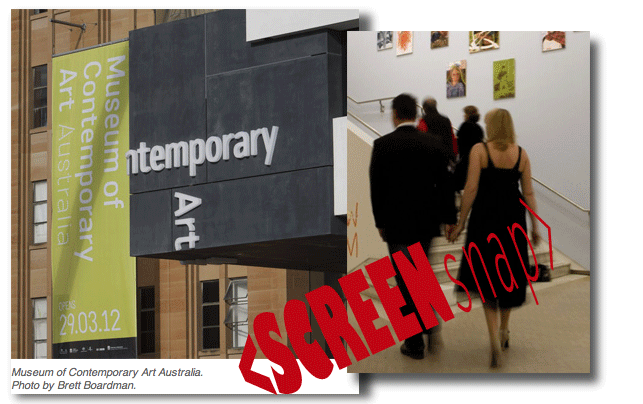
The MCA's 2012 Reopening Program Launches with Marking Time, Christian Marclay's The Clock, a new presentation of the MCA Collection, new commissions, performances and more. March 29, 2012 10am–5pm Daily, 10am–9pm Thursday Museum of Contemporary Art Australia 140 George Street The Rocks, Sydney, NSW 2000 mca.com.au ... On Thursday 29 March 2012 a new and significantly expanded Museum of Contemporary Art Australia will be unveiled to the public. The redevelopment transforms the MCA, with spacious new galleries including an entire floor dedicated to the MCA Collection; the National Centre for Creative Learning with state-of-the-art technology; public spaces that embrace one of the world's most famous locations, and a series of site-specific artists' commissions. Architect Sam Marshall in association with the Government Architect's Office has created a contemporary building that responds to its unique location and meets the needs of the Museum, bringing together old and new to create a context for engaging artists with audiences for the 21st century. The new MCA opens with Marking Time, which explores the ways in which artists visualise time, from family history and the failures of memory, to the ancient time of the planet or cosmos, to calendar cycles mapping the duration of the exhibition itself and its passing, across diverse media. Marking Time features works by: Edgar Arceneaux (US), Jim Campbell (US), Daniel Crooks (AU), John Gerrard (UK), Lindy Lee (AU), Tatsuo Miyajima (JP), Rivane Neuenschwander (BR), Tom Nicholson (AU), Katie Paterson (UK), Elisa Sighicelli (IT), and Gulumbu Yunupingu (AU). The highly acclaimed 24-hour video installation The Clock by Christian Marclay will occupy the largest gallery, Level 1, in the new wing. The Clock will be shown in its entirety on the MCA's opening day, then played continuously during regular museum opening hours. Every Thursday there will be a special 24-hour presentation of this work. The new MCA opens with a focus on its Collection, works acquired since the MCA was established in 1989. Volume One: MCA Collection, includes more than 150 Australian artists. Selected by MCA Curator Glenn Barkley, Volume One: MCA Collection reflects the diversity of Australian contemporary art over the past 20 years, including work by Aboriginal and Torres Strait Islander artists, the consolidation of film and video practice from a marginal to central position; the emergence of diverse cultural voices; as well as ephemeral and performative practices. Artists include... click here to find out more and read more


Click here to read more


MUSEUM MEMBERSHIP: The Tate's model for success

CLICK HERE TO GO TO SOURCE

There’s a great deal museums everywhere can learn from a program like Tate Members when we’re talking about 'online community building' and other activities where we want people to get together in an organised way around a cause. Here’s a couple of things to take away from repeating the Tate Members story at least 50 times:
  1. Have clear benefits ... invent things people can get FREE
  2. Keep repeating why people should join ... Because there are always new people being born that need to know 
  3. Outreach versus engagement ... Its as much about finding new members as keeping the old ones happy
  4. Treat different people differently ... Not everybody wants the same benefits ... Simply repeating your marketing message all the time might scare members away that have grown past being a member for the benefits
  5. Build a tribe ... The best thing about Tate Members is the welcome package– it makes you feel that you are part of Tate. These things are gold. 
  6. Be very, very serious about it  ... The moment people get together magic happens, and the moment they are invited to get together and the host isn’t in it for 120%, the party is ruined... We can bet on it that you remember such parties
  7. Click here to read more and get more

MUSEUMS: Who bloody well needs them?

CLICK HERE TO GO TO SOURCE
Museums today fill a different space in the imagination of people – especially people in the so-called developed world. With sites such as this one, and the myriad of others that fill the same kind of gap, who needs to visit a collection of dusty exhibits to satisfy their curiosity or even to spark it? Just who is going to a museum to stimulate themselves? Who is doing it more than every now and then?

Museums and art galleries operating on a 19th cum 20th Century model (mindset?) when colonialism was relatively fresh in our collective consciousness, and that celebrate the status quo, are arguably redundant. Children, by-and-large, are streets ahead of museum functionaries' thinking and very often are pretty much unimpressed by what they see in front of them. 

SOME people find new and unexpected ways to engage with these dusty places called museums – and sometimes takeaway interesting things. Likewise SOME museums and art galleries actively look  for ways blow away the dust and for new ways to engage with their audiences – children, students, researchers, citizens of all ages and cultural backgrounds, etc –and deliver culturally engaging  programs. 

Sadly too many museums and art galleries funded by 'the taxpayer' are loosing their credibility, their social license to operate, their sense of purpose, their vitality and whatever it was they once could rely upon to win the accolades of the communities they belonged to.

Albeit two quite different kinds of visitation, if your brain is hungry there is a choice of collections one might visit. For many they are just a 'mouse click' away and for others you may need to drive to town.

Jack Bauer

Friday, March 16, 2012

CHAMBERLAIN AT THE GUGGENHEIM NEW YORK

CLICK HERE TO GO TO SOURCE
February 24–May 13, 2012 

 Often identified as the artist who successfully translated Abstract Expressionism into three dimensions, John Chamberlain wound through Franz Schubert, the U.S. Navy, hairdressing, the Art Institute of Chicago, and the Black Mountain College poets on his path to art. In Chicago, Chamberlain admired the work of Willem de Kooning and David Smith and learned to weld. Black Mountain instilled in him an intuitive collage sensibility and an approach to language that favored the visual appearance and sounds of words, dissociating them from their definitions.

Friday, March 9, 2012

A PARADIGM SHIFT IN FURNITURE DESIGN

CLICK HERE TO FIND OUT ABOUT GODSPEED
CLICK HERE FOR GODSPEED ON flickr


The New Computing Paradigm on the Horizon and Museums

CLICK HERE TO GO TO SOURCE
CLICK HERE FOR ANOTHER STORY
Well we can probably look forward to the day when every exhibit can have its own computer and able to afford it. Also there is the promise of little robots cruising about in museums enriching the musing  and goodness knows what else. The sceptics say "its a way off yet" but there you go these same people said the same thing about iPODs and all kinds of things. 

One museum, the Santa Cruz MAH has worked out how to get iPODs in the museum – and very very cheaply. They are asking their community to donate their old iPODs to them. If you upgrade to an iTOUCH or an iPHONE you'll, as likely as not, you'll have a redundant iPOD. If you're not sure what to do with that iPOD that was such a big purchase back then, well you could give it a museum who wants to engage with its audience. 

That museum would offer you a way to redistribute your resources instead of throwing away something that has more technology in it than most things in your home and has an enormous amount of musing life left in it. ALL THIS CAN HAPPEN RIGHT NOW

Museums need iPODs, old and new, to play music, deliver sound bytes and more still in the galleries. MoNA in Hobart has started to work out what can be done with this kind of technology.  So take your forlorn and lonely iPOD to the front desk of a museum near you and test its relevance to the 21st C.  Your museum may well give it a new life, or  have a solution for you that supports local art and history in your community. 

A 21st C museum should be able to offer you a way to redistribute your resources instead of throwing away something that has more technology in it than your microwave. A 20th C museum would look to their collection policy and wonder if you iPOD would fit their collection policy.

Indeed yo may well have other superseded technology that could still do a job in a museum beyond being an exhibit!