Wednesday, August 7, 2013

The Te Papa BLOG

Categories 
CLICK ON A HEADING TO READ THE ENTRIES

Art (132)  Biodiversity (137)    Birds (88)    Penguins (23   Borrowing and Lending (34)    Bugs, insects and spiders (21)    Collections Online (183)     Colossal squid (141)   Conservation (38)     Cook Islands (1)     Copyright (4)     Crustacea (2)    Disasters (22)     Bay of Plenty oil spill (6)     Christchurch earthquake (9) Education (15)     Events (76)    Exhibitions (250)    Collecting Contemporary (11)    Slice of Heaven: 20th Century Aotearoa (48)   Field trips (92)  Fish (34)     Fossils (11)    History (173)    Fashion (51)   Textiles (20)     Kids (30)    Mammals (24)    Māori (65)     Museums (36)     News (31)    Pacific (83)     Photography (72)     Plants (153)     Bryophytes (3)    Ferns (54)     forget-me-nots (6)    Marine algae (1)    Orchids (4)  Plantago (1)     Pseudopanax (9)]    Sedges (3)    Veronica (1)   Reptiles (17)    Research (2)     Te Papa Press (10)     Warhol (5)    Whales (83)    Pygmy right whale (23) Whales | Tohorā (57)


Tuesday, August 6, 2013

A Bloody Good BLOG: Te Papa NZ

CLICK HERE TO VISIT THE BLOG
Fascinating sunfish facts

Te Papa recently received a rare sunfish specimen from Auckland Museum, so we decided to find out more about these mysterious ocean-dwelling animals. Here are our fascinating facts:

 1.Sunfish don’t have a tail! Some people call them a ‘gigantic swimming head’ (which seems a bit rude). Instead of a tail their dorsal and anal fins are fused together into a rudder-like structure called a clavus. The sunfish swims by flapping its dorsal and anal fins synchronously, like oars. This is a common sunfish, also called an ocean sunfish, Mola mola. Our specimen is the rarer sharp-tailed sunfish, Masterus lanceolutus.

 2. There are four species of sunfish: common sunfish (Mola mola), slender sunfish (Ranzania laevis), sharp-tailed sunfish (Masterus lanceolutus) and southern ocean sunfish (Mola ramsayi). The species at Te Papa is a sharp-tailed sunfish. Scientists know the most about the common sunfish, so we’re pretty excited to be able to find out more about the rare sharp-tailed sunfish.

 3. Sunfish are the heaviest bony fish species alive today. Common sunfish weigh around a metric tonne on average. The biggest common sunfish ever caught weighed over two metric tonnes!

Art Forum - Denise Green AM, Australian-American Artist and Writer


The Queen Victoria Museum & Art Gallery and the Tasmanian College of the Arts (Inveresk) invites people in Launceston to an Art Forum by Australian-American Artist and Writer 
Denise Green 
TIME: 
 12.30pm Thursday 12 September 2013 
PLACE: 
Gallery 2, QVMAG Art Gallery, Royal Park
2 Wellington Street, Launceston 
Admission is free 

RSVP by Monday 9 September 2013 on T 6323 3798 or E bookings@qvmag.tas.gov.au Friends please quote your membership number

Denise Green (born Melbourne 1946) studied at the Sorbonne in the late 1960s and received her MFA at Hunter College, New York in 1976. She has lived and worked in Australia and New York since 1972. 

Green first received public recognition through her participation in the Young American Artists: 1978 Exxon National Exhibition at the Solomon R. Guggenheim Museum, New York; and the seminal 1979 New Image exhibition at the Whitney Museum of American Art, New York. Over the last decade, surveys of her work have been shown at the Art Gallery of New South Wales, Sydney; MoMA PS 1, New York; and the Museum Kurhaus Kleve, Germany. Green is currently a senior visiting critic in the Graduate Department at the Pennsylvania Academy of Fine Arts. She is represented in all major Australian collections. 

She will talk about the challenge for an artist to fashion a career on three separate continents (Australia, North America and Europe) over four decades, from the late 1960s through to today. In her lecture she discusses her response to the dominant credo of the 1970s, which asserted that artworks should speak for themselves and that artists should not have to explain the underlying meanings in their work. In the 1990s she began writing about art to counter these arguments. She recounts how being more articulate about her work opened up a dialogue and helped cultivate relationships with galleries and museum curators in Europe and the USA. 

Denise Green is one of a small number of Australian artists who have established significant careers as artists internationally, whilst maintaining strong links with Australia. We are very privileged to host Denise Green's brief visit to Tasmania and warmly invite all those interested in art to attend this most significant forum.

Tuesday, July 9, 2013

Australian Age of Dinosaurs Museum

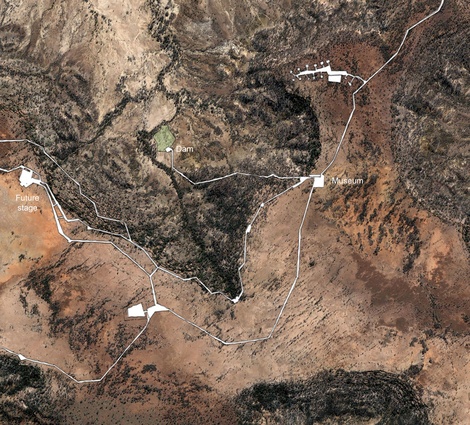
A site plan of the area.
In 1999 grazier David Elliott stumbled over a large fossilized bone on his property near the outback town of Winton, in central western Queensland’s “dinosaur triangle.” The bone belonged to a twenty-metre-long, four-legged dinosaur that lived more than ninety-five million years ago. The discovery was proclaimed as Australia’s largest sauropod find. 

After unearthing hundreds more fossils, David and Judy Elliott lobbied for funding to establish a museum near Winton to display the dinosaur bones. State and federal governments and the local council all chipped in and the architect and building contractor worked pro bono on the first phase of the building program, the reception centre for the museum. A local landowner gifted the Australian Age of Dinosaurs Museum of Natural History a mesa or “jump-up.” 

This dramatic, flat-topped outcrop of land rises steeply out of the extended plain, a commanding site. On top of the jump-up, the Elliotts first put up a big tin shed to serve as a workshop where tons of fossils being unearthed in the Winton region are cleaned, sorted and stored. 

The area has yielded the world’s largest collection of dinosaur bones. Next they planned for this small interpretive reception centre that has been built five hundred metres from the workshop. The Elliotts heard about an architect in Brisbane. It would be longer than a year before Cox Rayner took on the project, but when the architects did become involved, they were won over by the Elliotts’ enthusiasm and knowledge ... CLICK HERE TO READ MORE & GO TO SOURCE

Renowned potter Gwyn Hanssen Pigott dies, 77


CLICK HERE TO GO TO SOURCE
BALLARAT born ceramicist Gwyn Hanssen Pigott has died in London aged 77 after suffering from a stroke. The internationally renowned potter was born in 1935, and learnt the craft of ceramics from the ground up. Having received numerous awards including an Order of Australia medal in 2002, Hanssen Pigott was recognised as one of the most distinguished potters in Australia. 

Art Gallery of Ballarat registrar Anne Rowland said the former Ballarat and Clarendon College student travelled across the globe, training and working at leading potteries around Europe. She said Hanssen Pigott was renowned for turning ordinary items into works of art. 

“The styles of her arrangements and the finesse she would bring to making her objects means she will be remembered for a long time,” Ms Rowland said. From today, [JULY 8] the Art Gallery of Ballarat will showcase some of Hanssen Pigott’s work in the upstairs contemporary gallery. The work on display will include a set of inseparable bowls, a teapot, still-life arrangements and a dish spanning between 1978 and 1992.

Saturday, July 6, 2013

Think About This!

Democratic Museum Funding in Toledo


Local voters get one last chance to revive Toledo science museum
BY ALEX M. PARKER   BLADE STAFF WRITER
COSI, which operated in downtown Toledo for more than 10 years, has one final shot to convince voters for support, leaders say.

After failing twice, museum organizers are pulling out all of the stops spending at least $167,200 raised from private donations in a campaign to persuade Lucas County voters to reopen the museum.

Science and technology is the base of our work force. It's where we're going and where our county is going, said Lori Hauser, the museum s director of operations. COSI is around to spark a wonder in science and math and also to get people excited in this field.

Issue 37, the additional five-year, 0.17-mill levy request, would cost the owner of a $100,000 home about $5.21 a year, according to the county auditor. It would bring in $1.25 million annually for the science center s operations, according to levy advocates.

Local businesses such as Owens Corning, First Solar Inc., Xunlight Corp., and BP PLC s Toledo Refinery all said they would not only help fund the levy campaign but would also assist the museum once it opens with new exhibits.

It s a quality of life issue, not just for Toledo, but for all of Lucas County, Maumee Mayor Tim Wagener said.
COSI officials are sticking to a pledge they made during the last levy campaign in 2007 that, if reopened, the museum would have free admission for children from Lucas County on Saturdays, if they are accompanied by an adult.

The museum opened in 1997 and closed in December, 2007.

If the levy does not pass, Ms. Hauser said it would close permanently and its exhibits would be shipped to other museums.

TO GO TO SOURCE  ••• ABOUT THE MUSEUM ••• READ MORE


Saturday, June 15, 2013

Building an audience, a following and a community

CLICK HERE TO VIEW THE VIDEO
The Rijksmuseum 
A masterpiece on your desktop every day? The Rijkswidget shows you a different work from the collection every day, as well as information about the work and it’s artist. The museum has won international acclaim with it's"Rijkswidget".

Sunday, June 9, 2013

QUESTIONS ... 2013 Getty Artists Program: Sam Durant

    Sam Durant
    What #isamuseum?2013 Getty Artists Program
    May–July 2013
Each year, the J. Paul Getty Museum's Education department welcomes one established, mid-career artist to take part in its Getty Artists Program, allowing them to create and implement a project of their choosing. The artist is given the freedom to select an audience, and develop the focus and format of his or her project. Past Getty artists have included Mark Bradford (2010), Jennifer Steinkamp (2011), and John Divola (2012). For 2013, the Museum has invited Sam Durant, whose project will prompt visitors to the Getty Center and online to respond to thought-provoking questions about the role of museums. 
    Durant is a multimedia artist whose work features a variety of social, political, and cultural issues. Often referencing American history, his work explores the varying relationships between culture and politics, engaging subjects as diverse as the civil rights movement, Southern rock music, and modernism. 

    "It's important for museums like the Getty to engage with contemporary artists and our varied audiences," explains Timothy Potts, director of the J. Paul Getty Museum. "The beauty of this program is that it accomplishes both of those things. In working with artists like Sam, we partner with highly creative individuals and give them the freedom to work with us in engaging our audiences. We all learn new things through the process."

    Beginning May 1 and continuing through July 2013, Durant presents What #isamuseum?, a project prompting visitors to explore the functions and roles of museums in contemporary life. For the project, Durant has curated a series of provocative questions about the nature of museums including "Is a museum for everyone?" and "Is a museum political?," and posed these questions in unexpected places throughout the Getty Center site, such as on floors, tram windows, the "Today at the Getty" handouts that every visitor receives, and on paper napkins in the café.

    Visitors can respond to Durant's questions in several ways. An iPad station in the Museum's Entrance Hall will encourage visitors to share their thoughts with others on-site, where a monitor will spotlight responses in an effort to encourage dialogue. Responses to the questions can also be submitted via Twitter (@isamuseum and on the website http://www.isamuseum.org/.

    Explains Durant, "By expanding the conversation and encouraging different forms of response, participants can become active within the project and even change the debate around the initial issue." 

    On Tuesday, June 11 at 11am PDT, artist Sam Durant will participate in a live Google Art Talk http://www.e-flux.com/announcements/2013-getty-artists-program-sam-durant/ . He will be joined by Toby Tannenbaum (Getty Museum), Robert Sain (Centre for Living Arts), Pablo Helguera (Museum of Modern Art), and Jessica Cusick (City of Santa Monica). The group will discuss the function and role of museums, as well as the artist's role within it. Expanding upon What #isamuseum?, this discussion focuses on the purpose, importance, and politics of museums. 
      Additional information is available at http://www.e-flux.com/announcements/2013-getty-artists-program-sam-durant/.
      About Sam Durant
      Sam Durant's work has been widely exhibited internationally and in the United States. He has had solo museum exhibitions at the Museum of Contemporary Art, Los Angeles; the Municipal Museum of Contemporary Art in Ghent, Belgium; Govett-Brewster Art Gallery, New Zealand; and the Museum of Contemporary Art of Rome. Durant has taught at California Institute of the Arts in Valencia, California since 1995, and currently lives and works in Los Angeles.

      Saturday, May 11, 2013

      Museums and Prostitution

      CLICK HERE TO GO TO SOURCE

      A SMH EXCLUSIVE: 
      The Powerhouse Museum has been prostituted in pursuit of misguided populism, says one of Australia's leading arts figures.

      Leo Schofield also said millions of dollars had been wasted on renovating the building, in a withering attack on the management of the museum at Ultimo.
      ''As a former trustee of the Powerhouse Museum I am appalled at the recent history of this once vibrant institution and the whoring of a great and eclectic collection in pursuit of misguided populism,'' he said.

      Schofield's scathing comments came as Arts Minister George Souris announced on Wednesday that Rose Hiscock would replace Dawn Casey as director of the Museum of Applied Arts and Sciences, which includes the Powerhouse and the Sydney Observatory.

      But Ms Hiscock would inherit a troubled institution, said Schofield, who was a trustee for nine years.
      Schofield's views are rejected by Shirley Alexander, who became a trustee in 2007 and is deputy vice-chancellor of the University of Technology, Sydney.

      ''I think there are some people who will never agree that something deemed to be popular is the right thing for a museum,'' she said.
      ''We cater to all audiences, not just the elite.''

      Schofield is also critical of the museum's facelift that resulted in a gallery devoted to design being replaced by a temporary touring exhibition space and upgrades to the entrance, cafe and shop. ''Millions have been wasted on rejigging what was a perfectly fine building and the choice of recent directors has been questionable,'' he said.

      Schofield said the museum's reputation for collecting and exhibiting contemporary design had been harmed during Dr Casey's five-year tenure. Exhibitions on popular culture such as the Wiggles and The Chronicles of Narnia had come at the expense of decorative arts, crafts and design. ''What has got my dander up is the complete destruction of the design section of the museum,'' he said.

      Tasmania's Museum of Old and New Art and the refurbished Tasmanian Museum and Art Gallery showed it was possible to elevate public taste, not debase it, Schofield said.
      Schofield has been critical of Dr Casey, claiming in 2010 that many long-term museum supporters and donors viewed her appointment with ''considerable trepidation''.

      ''The institution is designated as a museum of applied arts and sciences but, bit by bit, the applied and decorative arts are being de-emphasised and the program of exhibitions dumbed down,'' he said in 2010.

      A former director of the Sydney Festival, Schofield said: ''The tsunami of goodwill that once flowed to this institution has dwindled to a trickle''.

      His criticism was echoed by the NSW Auditor-General, who gave a harsh report of the museum's performance in 2011.

      The report found there was a ''dramatic decrease'' in the number of exhibitions held, while its Top Secret and ABBAWorld shows were so unsuccessful that the museum removed admission charges.

      In contrast, Harry Potter: The Exhibition, which opened in November 2011, drew large crowds and helped contribute a profit of $2.7 million to the museum in 2011-12.

      Professor Alexander said the renovation was prompted by visitor feedback that the museum was hard to navigate. ''We put a lot of money into re-engineering the space and fixing signage so when visitors come we want them to have the best possible experience,'' she said.

      She said Dr Casey had addressed the lack of attention to science, innovation and engineering with new shows.

      Friday, May 10, 2013

      GLASShouse Night Sounds # 1


      The inaugural performance of Night Sounds #1 on Wednesday, December 12, 4:30-6:30pm, featured musician Julianna Barwick in the Glass House alongside Ken Price’s sculpture Doola (2011). Julianna Barwick: Hauntingly beautiful & immersive, the music of vocalist/composer Julianna Barwick becomes a total experience of the senses when paired with sublime design. Barwick has released three albums to tremendous critical acclaim from The New York Times, National Public Radio (NPR), Pitchfork and more. The interface between voice and technology is central to Ms. Barwick’s art: her music is composed of raw material almost exclusively her own voice, layered and processed into figures that can alternately be described as familiar, soothing, alien, and tense... CLICK HERE TO GO TO SOURCE

      40 Fruit


      Tree of 40 Fruit, 2008-Present
      Grafted fruit tree including peach, plum, apricot, nectarine, cherry, and almond
      Courtesy of the artist and Ronald Feldman Fine Arts

      Wednesday, May 1, 2013

      WHAT CAN AND CANNOT BE DONE


      If you are proposing to do something out of the ordinary, a little unusual, that contests the status quo, that involves change or even something quite simple, there is bound to be a whole list of reasons as to why in cannot, should not, must not, will not, be done.

      The Auxiliary Museum is attempting to build an online ‘exhibit’ of these reasons given for NOT doing something in a museum. Indeed we are attempting to compile a definitive list so that people who come across idea blocks can recognize them for what they are – bureaucratic stalling devices. If as a musing visitor you are wishing to encourage the unexpected, the atypical or some other curious outcome, or even some other laudable outcome that challenges ‘the norm’ we hope that we can help you  muse upon these things when you hear them or bump up against them in some way. If you find a new manifestation please let us know.

      Any unwelcome, extraordinary or unexpected initiative from an outsider or cultural activist can be delayed until after the next meeting, sustainability conference, review session, whatever, by a bureaucrat or functionary somewhere via a 'multi stage and multi facted' delaying process:
      1. Informal discussions with appropriate people;
      2. Draft proposal developed by suitably qualified people;
      3. Preliminary study formatted to meet the required standards;
      4. Discussion document drafted to meet the need of the appropriate authorities;
      5. In-depth study investigating the concerns of appropriate authorities;
      6. Revised proposal that addresses the issues identified in the earlier studies;
      7. Policy statement that accommodates the issues identified in previous reports and studies;
      8. Strategy proposal towards delivering the anticipated outcomes;
      9. The assessment of human resource capacities and needs
      10. Discussion of strategy to ensure that the process is as inclusive as required by key stakeholders;
      11. The application of fiscal resources
      12. Implementation plan circulated to ensure that all impacted upon by the proposal are included in the process;
      13. Revised implementation plans to accommodate unanticipated issues;
      14. Authority agreement to proceed conditional upon any new factor that may have arisen


      NOTE: The funding agency does not work out what is needed and then think how to raise the money. It pitches for as much as it can get away with from wherever it can get the funding and then it thinks how to spend it.


      If you have experienced, or are experiencing, other inhibitors please email zero@7250.net for our records and where possible for any assistance we are able to supply.

      ACKNOWLEDGEMENT: This list draws upon Antony Jay's and Jonathan Lynn's 'Yes Minister' tweaked somewhat to fit the MUSERSworld