Saturday, July 21, 2012

DAIMLERminimalism

click here for installation views
The first exhibition in the 'Minimalism Germany 1960 series in 2010 comprehensively showed major trends in reduced, abstract 1960s art in Germany from the Daimler Art Collection. The second part concentrates on a small number of protagonists who essentially represent a specifically German aspect of Minimalism as an international trend in the 1960s with large-scale work, serial picture objects and action-oriented work concepts. The exhibition takes the example of striking protagonists, bringing together about 40 works to reflect on trends in Conceptual Art, Minimalism and seriality, linked with the cities of Frankfurt, Düsseldorf, Hamburg, Stuttgart and Berlin ... click here to read more

Dieter Roth @ Fruitmarket Edinburgh


Dieter Roth Diaries 2 August–14 October 2012 The Fruitmarket Gallery 45 Market Street, Edinburgh,  http://www.fruitmarket.co.uk ... http://www.fruitmarket.co.uk/exhibitions/archive/ 

The Fruitmarket Gallery is proud to present this exhibition of the work of Dieter Roth (1930–1998), one of late-twentieth-century art's major figures. Roth was an artist of astonishing breadth and diversity, producing books, graphics, drawings, paintings, sculptures, assemblages, and installation works involving video, sounds, and recordings. He was also a composer, musician, poet, and writer ... Art and life for Roth flowed readily into each other, and much of the material for his artistic output came from his everyday life. This exhibition is the first to focus on the theme of the diary in Roth's work. Roth kept a diary throughout his life, and saw all art-making as a form of diary keeping. His diaries were a space to record appointments, addresses, lists, and deadlines but also ideas, drawings, photographs, and poems. They teem with graphic exuberance, and proved a rich source for his work. The Fruitmarket Gallery is fortunate in being able to show Roth's diaries to the public for the first time, as well as the hand-produced, photocopied 'copybooks' he made from them to sell to favoured collectors and friends, and two major installation works. Many of Roth's major works can be understood as kinds of diaries.

Friday, July 20, 2012

Poetry & Pottery


click on the image to enlarge
FOUNDplace for the poetry is at the 
Château d'Angers [click here], Loire Valley, France.

Image courtesy of GOOGLEearth
click on the images to enlarge
FOUNDplace for the pottery [Pole of Porcelain]   is 
a few ks upstream at the village of Mehun-sur-Yèvre

Image courtesy of GOOGLEearth
FINDER: Tim Thorne 2012

Wednesday, July 18, 2012

OLYMPICS X 2012

click here to experience the poetry
"Two thousand and twelve words, six thousand and thirty six syllables, sixteen thousand and ninety six letters"

art and resistance

click here to go to source and take the tour

Disobedience Archive is an ongoing, itinerant atlas of the various contemporary resistance tactics: from direct action to counter-information, through constituent practices and forms of bio-disobedience. It accommodates a variety of film material by artists, activists, filmmakers, philosophers and political groups ... The selection of films is organised in eight chapters: the first is about the 1977 demonstrations and riots in Italy, followed by sections on social changes around the Berlin Wall, the social upheavals in Argentina in 2001, the anti-globalization movement’ developments from 1994 onwards, experimental forms of education, community and urbanism, the Israel-Palestinian conflict, political and activist work in the former Eastern Bloc, the effects of 09/11 and a new section dealing with events surrounding what has come to be called the Arab spring.

Monday, July 16, 2012

SWISS INSTITUTE IN NEW YORK

click here to go to source


For her exhibition, Weinberger has composed a series of electronic loops mixed in a constant cadence that recalls the rhythmic pulse of a beating heart (80-140 beats per minute). While minimal, the various tracks resound in a warm, constant and reassuring tempo that is soft, drawn out, and ambient. The loops are installed via a series of multi-directional speakers, each emitting sound. Long white curtains adorn the walls ... click here to read more

QVMAG …come to life…

click here for more information 
A collaborative exhibition generated by CAST & QVMAG in Launceston
.•.
The Examiner: Disturbing images give life to new exhibition ... click here

King of Twee and Painter of Light

Click here for KINKADEinformation


CLICK ON THE IMAGE TO ENLARGE
Thomas Kinkade (January 19, 1958 – April 6, 2012) was an American painter of popular realistic, bucolic, and idyllic subjects. He is notable for the mass marketing of his work as printed reproductions and other licensed products via The Thomas Kinkade Company. He characterized himself as "Thomas Kinkade, Painter of Light," a phrase he protected through trademark but one originally attributed to the English master J.M.W. Turner (1775–1851). He was claimed to be "America's most-collected living artist" before his death with an estimated 1 in every 20 American homes owning a copy of one of his paintings. The world has lost a phenomena – or at least the USA has.

Links to KINKADEstories [1] [2] [3]

Saturday, July 14, 2012

Friday, July 6, 2012

QR Something on Cultural Tourism


New Global QR Paradigm For Museums & Art

CLICK HERE TO GO TO SOURCE

QR CODES EXPLAINED CLICK HERE
The world is changing and the ground is shifting – and constantly. What's true of the world is just as true in musing places (museums!) an QR CODES are appearing all over, even in museums. In musing paradigms QR CODES  offer new opportunities for curator to engage with musers both inside the museum and outside it. Recalcitrant curators will want to maintain the status quo but it is too late by far and QRart is upon us and as likely as not facilitating multifarious understandings of 'things'.   
CLICK HERE TO GO TO SOURCE

Negative Space

CLICK HERE TO GO TO SOURCE
Rachel Whiteread‘s sculptures draw our attention to the concept of space, something that rarely think about even though we spend our lives navigating 'space'. Mostly we are blissfully unaware of the space/spaces we occupy. Working to take negative space and make it a tangible reality, Whiteread uses her sculptures in order to physically define what surrounds, and indeed defines, objects. 

Using casting materials such asresin, plaster and rubber, she casts the negative space surrounding domestic and household objects. Through her sculptures, Whiteread explores ideas of absence, memory, and architecture, revealing the space we cannot define and rarely pay attention to ... click here to read more about Whitehead.

Sunday, July 1, 2012

Zhejiang Provincial Museum, Hangzhou

Click here to go to the Wuzhou Celadon Jar

Click here to go to the "X-ray Pig"

Established in 1929, Zhejiang Provincial Museum (formerly known as the West Lake Museum of Zhejiang Province) is a comprehensive museum devoted to humanity studies integrating collection, exhibition and research with its over 100,000 collected cultural relics.

Among them, there are many world-famous exemplars, including pottery wares, lacquer wares, wooden pieces, bone tools and ivory objects of pre-historic Hemudu Culture, jade and silk fabrics of pre-historic Liangzhu Culture, bronze wares of the ancient Yue State, celadon wares of the Yue Kiln, Longquan Kiln and the Southern Song Imperial Kiln, copper mirrors of ancient Guiji and Huzhou, works of calligraphers and painters of Zhejiang Province in the Ming and Qing Dynasties.

 At present, the Museum features some principal exhibitions, e.g. “Seven Thousand Years of Zhejiang  – Exhibition on Zhejiang’s Historic and Cultural Relics”, “The Best of Celadon” and “Exhibition on Folk Customs of Ancient Yue Families”. With rich and colorful cultural relics throughout history and unique display methods, these exhibitions reflect the long and enduring history of Zhejiang Province in various layers and from diversified angles. 

The Zhejiang Provincial Museum irregularly holds about 40 exhibitions from home and abroad every year.

Within the museum there is the Hangzhou Cultural Relics Protection & Scientific Research Base. The Base is financed by the People’s Government of Zhejiang Province, completed in May 2004 and is now a cultural relics protection & scientific research base in the service of the whole cultural and museum system of Zhejiang Province. The Base aims at providing solutions to the existing problems in the cultural relics protection and research in the museums of Zhejiang Province, spreading basic cultural relics protection techniques to the Province and key technical services to the whole country, with the support from Zhejiang Provincial Museum.

MONEY, ARTISTS & MUSEUMS


SURVEY SAYS:
the W.A.G.E. Artist Survey
results are in!
www.wageforwork.com


W.A.G.E. Manifesto online


W.A.G.E. = Working Artists & The Greater Economy


W.A.G.E. is based in New York but in many ways it is the fraction that represents the whole


W.A.G.E. is a work-in-progress with an agenda to provide an equitable fees schedule and 'best practice' models by late 2012


The results of the 2010 Artist Survey are now available at the new W.A.G.E. website. Read or download the complete report and survey results in graphic form here.


In 2010 W.A.G.E. launched an online survey to gather information about the economic experiences of artists working with over 67 nonprofit arts institutions in New York City's five boroughs between 2005 and 2010. The survey collected data about how cultural producers were compensated for exhibitions, performances, screenings, and lectures.

The results indicate that there is little consistency in institutional payment practices across New York’s five boroughs, with compensation ranging from full coverage of expenses and the payment of fees to no remuneration of any kind.

In response, W.A.G.E. is developing a certification program that will recognize nonprofit organizations that voluntarily adhere to an established best practices model and demonstrate a history of – and commitment to –paying artist fees that meet a minimum payment standard. W.A.G.E. Certification is being developed through a Research Partnership with Artists Space, together with active participation of the public. For more information about past and future programs please visit the W.A.G.E. website and Artists Space online.

the auxiliaryMUSEUM Tasmania has joined W.A.G.E

Founded in 2008, Working Artists and the Greater Economy (W.A.G.E.) is a New York-based activist group that focuses on regulating the payment of artist fees by nonprofit art institutions, and establishing a sustainable model for best practices between cultural producers and the institutions which contract their labor. W.A.G.E. is a 501c3 nonprofit organization. Find them at www.wageforwork.com.

W.A.G.E. works to draw attention to economic inequalities that exist in the arts, and to resolve them.

W.A.G.E. has been formed because as visual & performance artists and independent curators, artists provide a work force. W.A.G.E. recognizes the organized irresponsibility of the art market and its supporting institutions, and demands an end of the refusal to pay fees for the work we’re asked to provide: preparation, installation, presentation, consultation, exhibition, and reproduction. 

W.A.G.E. refutes the positioning of the artist as a speculator and calls for the remuneration of cultural value in capital value. 

W.A.G.E. believes that the promise of exposure is a liability in a system that denies the value of our labor. As an unpaid labor force within a robust art market from which others profit greatly, W.A.G.E. recognizes an inherent exploitation and demands compensation. 

W.A.G.E. calls for an address of the economic inequalities that are prevalent, and pro-actively preventing the art worker's ability to survive within the greater economy. 

W.A.G.E. advocates for developing an environment of mutual respect between artist & institution. 

W.A.G.E demands that artists receive payment for making the world more interesting. 

Saturday, June 30, 2012

Celebrating 125 Years of History

CLICK HERE TO GO TO THE MUSEUM
The National Museum of Singapore has a history that goes back to 1887. It is Singapore's oldest museum but at the same time it is a progressive institution. The museum is the custodian of the 11 National Treasures, and its History and Living Galleries are at the cutting-edge of 21st Century approaches to presenting history and culture. In many ways the institution redefines the museum experience. 

The museum is a cultural and architectural landmark in Singapore. It hosts innovative festivals and events all year round plus thought-provoking exhibitions that bring to light critically important collections of artefacts. 

The National Museum of Singapore re-opened in December 2006 after a three-year redevelopment, and is celebrating its 125th anniversary in 2012.

Wednesday, June 27, 2012

THE FUTURE: Independent Curation ... a way forward


TAKE NOTE: Independent Curators International (ICI) is producing the Curatorial Intensive: Curating Beyond Exhibition Making, the first short course to offer training to curators on the concepts and logistics of organizing public events, workshops, and other discursive program formats. Topics under discussion will include new formats for durational pedagogical projects and the production of events and curatorial publications, as well as more traditional museum education models. Central to all sessions will be discussions discerning audience and publics, and the consideration of time and space in relation to programming.

Recognizing there are few opportunities for professionals to receive practical training and guidance while also working, the Curatorial Intensive is targeted toward self-motivated individuals—working independently or in institutions—who would benefit from a week of intensive conversations around issues and questions that arise for curators. These range from the pragmatics of developing a program and building working relationships with artists, to the theoretical aspects of understanding how to turn a concept into a project and effectively communicate ideas ... click here to learn more

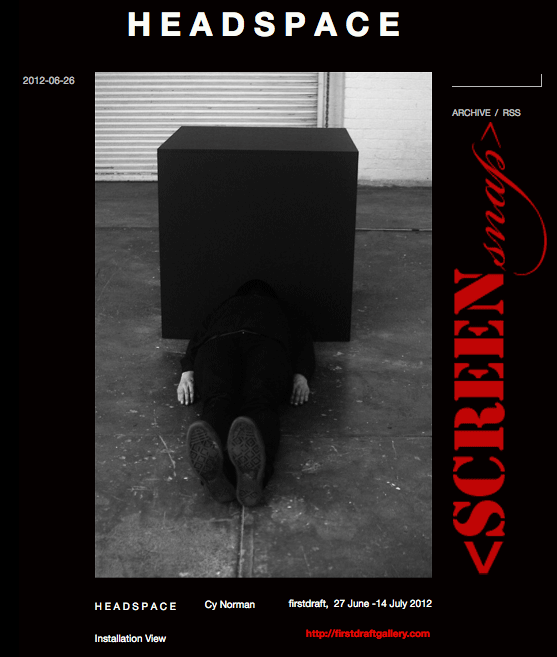
HEADSPACE


CLICK HERE TO GO TO firstdraft

CLICK HERE TO GO TO THE IMAGE SOURCE

The viewer lies down, on their back, on the gallery floor in order to place their head inside HEADSPACE. It is a listening space. Their body lies outside the space and is vulnerable. Their spacial perception is altered inside and out. In the darkened HEADSPACE the viewer becomes focused on the audio amplified inside the space, undistracted.

In HEADSPACE the passivity of the viewer is challenged, as they are asked to experience the work in a way that they are not familiar with. By positioning the viewer in such a way, they are perhaps uncomfortable both physically and psychologically. There is nothing to see once inside, only listen. The audio input into HEADSPACE will change throughout the exhibition period.

Tuesday, June 12, 2012

A MUSINGplace ONLINE OUT OF NEW YORK

CLICK HERE TO GO TO SOURCE


Danyel Ferrari
b. Lewiston, ME
Concentration at Hunter: Combined Media
BFA/BA, School of the Art Institute of Chicago, Chicago, IL, 2007

Untitled
Every PDF assigned throughout undergraduate and graduate degrees, partially eaten by termites
50 x 8 x 10”
If one is looking for an exemplar of a rich online exhibition – MUSINGplace –  this would be one even if it somewhat 'translates' the WHITEbox experience to a fairly standard DIGITALexhibit of current cultural production  – but one that is nonetheless rhizomic. 

It is however a richer experience than a print catalogue and again an exemplar for the replacement of so many mediocre, and expensive, hardcopy exhibition catalogues produced at great cost – typically redundant and found in a head, and all unread, in so many curators' offices. 

Reassuringly simple to navigate, THE HUNTER MFA THESIS EXHIBITION online, is worth 'surfing' through and from the site. Its a demonstration of the 'walllessness' of CYBERspace and the limits – mostly unnecessary limits – of imagination so evident in other online exhibition manifestations.

But Hunter College so often sets the pace in so many things. What is quite illuminating to look carefully at the language the institution and its 'students' use to describe their practices etc.

Monday, June 11, 2012

MUSE11/4:11: Shorter Days Longer Shadows

CLICK HERE TO GO TO SOURCE

A MUSE: 11 mins @ 11: 11 am June 11 SOMEwhere

CLICK HERE TO GO TO SOURCE

COLORmuse

CLICK HERE TO GO TO SOURCE

CLICK HERE JUST FOR FUN

HTML Color Codes

The HTML Color Codes exhibition features a selection of internet based artwork that address the topic of digital color. The central question that the exhibition poses is whether or not artists working with the internet are in fact limited to a “ready-made” color palette –  a premise that many artists working with film, photography, and mass produced, standardized paint sets have assumed. The rationale for this question stems from theories of perception that argue that color is a not ready-made object found in a paint set or machine, but rather it is an experience that results from a complex process of light interacting with the retina and human nervous system. The exhibition begins and ends along a polemic – on one extreme, color is viewed

RHIZOMIC GLEANINGmuse

CLICK HERE TO GO TO SOURCE

CLICK HERE TO GO TO THE SOURCES SOURCE

RHIZOMIC MUSEUM ONLINE SINSE 1999

CLICK HERE TO GO TO SOURCE

Founded in 1999, the Rhizome ArtBase is an online archive of digital art containing over 2,500 art works. 

Encompassing a vast range of projects from artists all over the world, the ArtBase provides an online home for works that employ materials such as software, code, websites, moving images, games and browsers towards aesthetic and critical ends. Its a whole new museology paradigm.

The mission of the ArtBase is to provide free, open, and permanent access to a living and historic collection of seminal new media art objects. 

As any artist who has worked with technology for more than a few years can verify – things break, browser support disappears, software compatibility changes, links expire, things change. 

Rhizome aims to ensure the longevity of these works – digital cultural production – not only to ensure that years from now an accurate record of this period of creativity and culture exists, but also to enable researchers to interact with and observe these materials in their intended forms – Rhizome is a true museum in a new paradigm.

Mitigating obsolescence while respecting artistic intent is a direct extension of Rhizome's primary mission of supporting and promoting art engaged with emerging technologies. 

Artworks entered into the archive through artists submissions, annual commissions and special invitation. We welcome submissions to the ArtBase – they are reviewed by our curatorial staff on a regular basis.

Sunday, June 10, 2012

ONLINE MUSEUM FROM SYDNEY

CLICK HERE FOR THE SYDNEY ETERNITY STORY

CLCK HERE FOR THE SITE
THE ONLINE MUSEUM DEDICATED TO: Musings on contemporary art issues from Sydney, Australia. Graffiti, street culture, urban painting, new media art, Second Life, blogging, internet resources, music, film, video & anything else that comes up.


ARTHER STACE'S chalked 'ETERNITY' still exist in the living memory of so many Australians and Sydneysiders. Arthur's life's work, his graffiti, deserves to be engraved in Australia's cultural memory for its endurability, persistence and politeness. Arthur touched so many people's lives in an enduring way albeit so often, very briefly .... click here for more on Arthur

Friday, June 8, 2012

THINGmapping

CLICK HERE TO GO TO SOURCE

ALWAYS

CLICK HERE TO GO TO SOURCE
If this is cultural production, where does it belong?

WOLFGANG LAIB’S CULTURAL PRODUCTION

CLICK HERE TO GO SOURCE
The German artist Wolfgang Laib and his installations using beeswax, rice and pollen that he collects laboriously by hand poses the question for some ... IS THIS REALLY ART? 

Wolfgang Laib finds spirituality in the simplicity of everyday, organic substances – milk, pollen, beeswax, rice – that provide sustenance or engender life. In 1975 he created his first Milkstone in what has become an ongoing series of elemental works (sculptures?). A rectangular block of polished white marble containing a slight depression on its upper surface, the piece is filled with a thin layer of milk to foster the illusion of a solid form. Though an inert object, this work/installation/performance requires ritualistic participation. 

Laib performs the first act of pouring the milk when the piece is displayed, but after this initial gesture, the collector – or museum staff – must clean and refill the stone each day it is on view. 

Laib displays his laboriously gathered pollen in simple glass jars or sifts it through sheets of muslin directly onto the floor to create large, square fields of spectacular color. He also molds the brilliantly pigmented dust into cones, as in The Five Mountains Not to Climb On. Though intimate in scale and intensely fragile, this hazelnut pollen work alludes to the monumentality suggested by its title. The notion that there is infinitude in the infinitesimal is beautifully manifest in Laib’s spare but highly aesthetic practice. 

More information via Sean Kelly Gallery  

art, art installation, beeswax, installation, pollen